


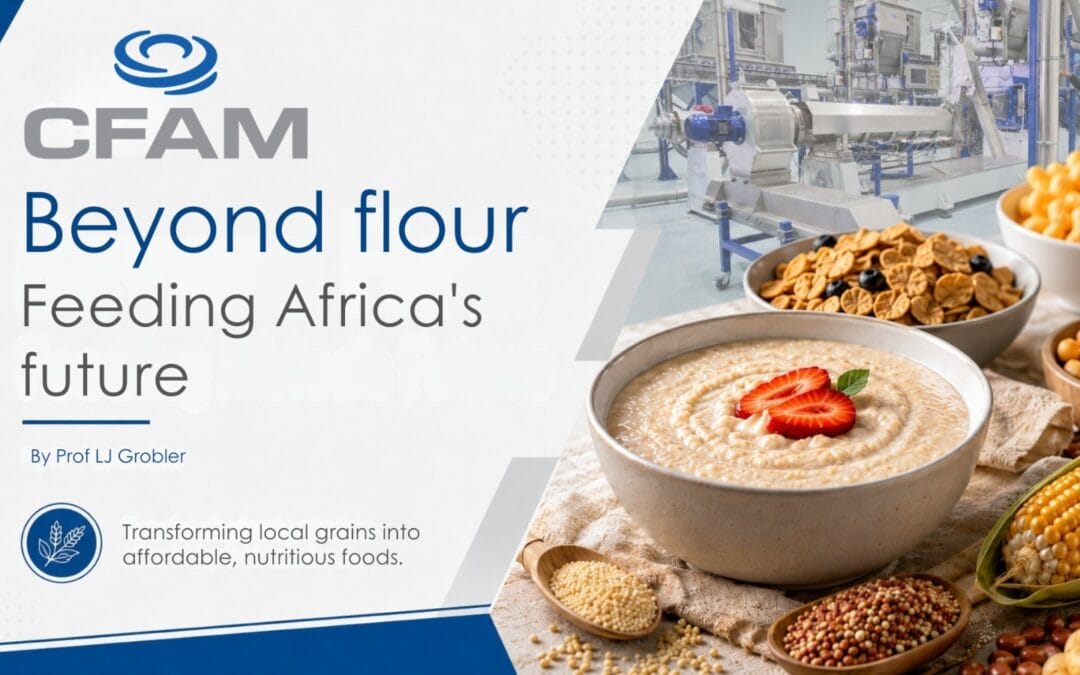
By Prof LJ Grobler, Director, CFAM Technologies
Africa’s future will be shaped by many factors, but perhaps none more important than how we feed our people. Today, the continent is home to approximately 1.5 billion people. By 2050, that number is expected to approach 2.5 billion. At the same time, Africa is urbanising faster than almost any other region in the world. Millions of people are moving into cities in search of opportunity, and with urbanisation comes a fundamental shift in the way food is consumed.
People have less time than previous generations. Parents work longer hours, children spend more time at school, and commuting often consumes a significant part of the day. Preparing meals from scratch becomes increasingly difficult. Yet despite these changing lifestyles, one thing remains constant. People still need food that is safe, affordable and nutritious.
The challenge facing Africa is therefore not simply how to produce enough food. The challenge is how to provide good food that fits the realities of modern African life.
“Africa does not lack agricultural potential. The challenge is transforming what we grow into foods that nourish people affordably, conveniently and at scale. Extrusion gives us the ability to do exactly that.” – Prof LJ Grobler
For decades, discussions around food security have focused primarily on increasing agricultural production. Producing more maize, more wheat and more rice remains important. However, as populations grow and lifestyles evolve, food processing becomes equally important. The grains we grow must be transformed into foods that people can prepare quickly, store safely and afford regularly.
This is where extrusion technology has the potential to transform the continent.
Extrusion combines heat, moisture and mechanical energy to convert grains and legumes into products that are safe, shelf-stable and easy to prepare. The process improves digestibility, reduces microbial contamination and creates foods that can often be prepared in minutes rather than hours. In simple terms, extrusion transforms agricultural crops into practical nutritional solutions.
The exciting reality is that Africa already produces many of the ingredients needed to make this possible. Maize remains the dominant staple across much of the continent. Sorghum and millet have nourished African communities for centuries. Rice consumption continues to increase, while wheat remains an important component of many diets. Legumes such as soybeans, cowpeas and Bambara groundnuts offer valuable and affordable sources of protein.
Individually, these ingredients provide important nutritional benefits. Combined intelligently, they become even more powerful.
By blending grains and legumes, manufacturers can produce multi-grain foods with improved protein quality, higher fibre levels and enhanced micronutrient content. Products become more nutritious while remaining affordable and rooted in local agriculture. Affordable nutrition does not have to depend on expensive imported ingredients, nor does it always require costly animal proteins.
For many African families, meat is consumed occasionally rather than daily because of its cost. Yet carefully formulated grain and legume combinations can provide meaningful nutritional value at a fraction of the price. This does not mean replacing meat altogether. It means expanding access to quality nutrition for millions of households that need practical and affordable alternatives.
Breakfast presents one of the greatest opportunities. Too many children leave home without eating a nutritious meal because mornings are rushed and preparation takes time. Instant porridges produced through extrusion can be prepared within minutes using only hot water. A mother rushing to work can provide her family with a nourishing breakfast before the day begins. A child can start the school day with energy and essential nutrients. A busy professional can enjoy convenience without sacrificing health.
Lunch presents another important opportunity. Across Africa, school feeding programmes play a critical role in supporting education and nutrition. Hospitals, factories and community kitchens face the challenge of feeding large numbers of people efficiently and consistently. Extruded products can be formulated specifically for these environments. They require minimal preparation, maintain consistent quality and can be designed to meet defined nutritional requirements.
Nutritious meals can therefore be delivered at scale. The impact extends far beyond the dining table. Better nutrition supports improved concentration, stronger immune systems and enhanced educational outcomes.
Dinner, too, can be transformed. Consumers still value traditional meals and familiar eating experiences. They seek comfort, satisfaction and foods that bring families together. Modern extrusion technology allows products to be developed with different textures and functionalities. Some products can be prepared as smooth instant porridges. Others can provide thick, hearty meals with stew-like consistencies that resemble traditional dishes.
Families can enjoy satisfying evening meals without spending hours preparing them. Cooking times decrease, fuel consumption falls and convenience improves, while the familiar comfort of home-style meals remains.
“Extrusion allows us to produce breakfast, lunch and dinner solutions from the same technology platform. It gives manufacturers the ability to meet consumers wherever they are in their daily lives.” – Prof LJ Grobler
One of extrusion’s greatest strengths is its flexibility. Products can be formulated to meet very specific nutritional objectives. Protein levels can be increased. Fibre content can be adjusted. Vitamins and minerals can be added according to defined requirements. Whether the objective is a complementary food for infants, a school meal, an emergency relief product or a nutritious family meal, extrusion provides the ability to meet those needs.
Post-extrusion fortification strengthens this capability even further. Many vitamins are sensitive to heat and may lose potency during conventional processing. By adding vitamins and minerals after the cooking process has been completed, manufacturers can improve nutrient retention and ensure that consumers receive the nutritional benefits intended by the formulation.
The result is food that not only fills stomachs but genuinely improves health. Food that helps address micronutrient deficiencies. Food that contributes to healthier communities. Food that changes lives.
There is also a powerful economic story behind this opportunity. Africa’s growing population represents one of the world’s largest emerging consumer markets. Demand for convenient and nutritious foods will continue to rise. Millers have an opportunity to move beyond commodities and become manufacturers of branded nutritional solutions. Farmers can benefit from increased demand for locally grown crops. Employment opportunities can be created through value-added food processing.
Food security and economic development can advance together.
Too often, discussions about feeding Africa focus only on the magnitude of the challenge. Perhaps it is time to focus on the opportunity instead. Africa has fertile land. Africa grows diverse crops. Africa has entrepreneurs willing to innovate. Africa has consumers looking for better solutions.
What we need is the ability to transform these resources into foods designed for modern realities.
Extrusion provides that bridge. It allows us to convert the grains and legumes already grown across the continent into safe, affordable and nutritious meals for breakfast, lunch and dinner. It enables us to improve nutrition without sacrificing convenience. It supports local agriculture while creating profitable businesses. Most importantly, it gives us an opportunity to shape a healthier future.
“The future of Africa will be shaped not only by how much food we produce, but by how effectively we convert our agricultural resources into foods that improve lives. Extrusion has the potential to become one of the most important tools in that journey.” – Prof LJ Grobler
Africa’s population is growing. Its cities are expanding. Its needs are changing.
The future of African milling lies beyond flour. It lies in creating foods that nourish people, strengthen communities and unlock the full potential of the continent’s agricultural resources.
The opportunity before us is extraordinary.
The question is not whether Africa can feed its future.
The question is whether we are bold enough to rethink how we do it.
#BeyondFlour #CFAMTechnologies #FeedAfrica #FoodSecurity #AffordableNutrition #ExtrusionTechnology #InstantPorridge #SchoolFeeding #MultiGrainNutrition #FutureOfMilling #FoodInnovation #MadeInAfrica #NutritionForAll #ValueAddition #TransformingAfrica #FoodManufacturing


