


By Prof LJ Grobler, Director, CFAM Technologies
Africa’s future will be shaped by how effectively we feed a rapidly growing and increasingly urban population. Today, the continent is home to approximately 1.5 billion people, and by 2050 that number is expected to approach 2.5 billion. As more people move into cities, lifestyles are becoming busier and consumers are demanding foods that are safe, nutritious, affordable and convenient. Meeting these needs will require more than producing additional grain. It will require technologies capable of transforming Africa’s agricultural resources into practical nutritional solutions that fit modern life.
Extrusion technology is one of those solutions. For decades it has been used to produce breakfast cereals, snacks, pet foods and instant porridges. Today, however, extrusion offers Africa an opportunity to create affordable, nutritious foods using locally grown grains and legumes while building sustainable food industries. It enables millers to move beyond commodities and become manufacturers of value-added nutritional products.
A question often asked is: What is the difference between single screw and twin screw extrusion, and why does it matter?
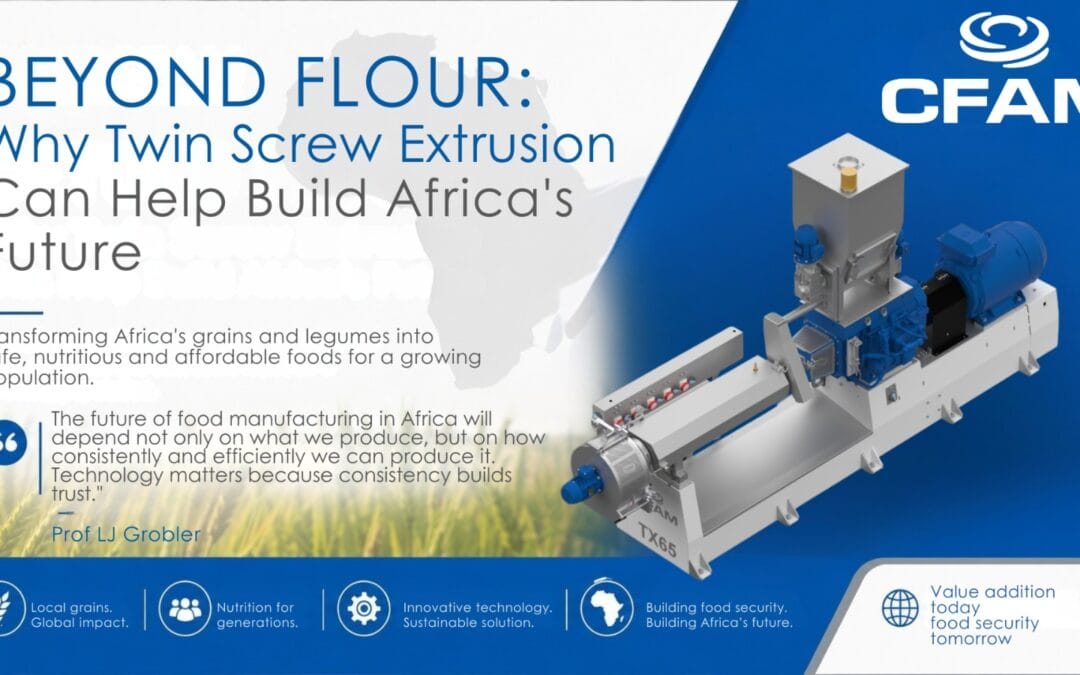
“The future of food manufacturing in Africa will depend not only on what we produce, but on how consistently and efficiently we can produce it. Technology matters because consistency builds trust.” – Prof LJ Grobler
Both single screw and twin screw extruders work on the same principle. Ingredients enter the barrel and are subjected to intense mixing, pressure and friction. This mechanical energy rapidly generates heat, cooking the product in seconds. During this process, starches are gelatinised, proteins are modified, digestibility improves and microbial contamination is reduced. The result is a safe, shelf-stable product with improved functionality.
The key difference lies in how material moves through the extruder. In a single screw extruder, the flow rate depends largely on the viscosity of the material being processed. Viscosity is influenced by particle size, moisture content, ingredient composition, fibre levels, protein content and the natural variability of raw materials. When these factors change, viscosity changes. This affects the rate of product flow through the barrel, which influences residence time and ultimately the cooking conditions. As a result, product characteristics such as expansion, density and texture may vary.
This does not mean single screw extrusion is inferior. Single screw systems remain highly effective and continue to provide excellent solutions for many traditional applications. Maize-based snacks, certain breakfast cereals and numerous pet food products are manufactured very successfully using this technology. For relatively simple formulations and consistent raw materials, single screw extrusion often provides a robust and cost-effective option.
Twin screw extrusion, however, offers a different approach. Rather than relying primarily on viscosity to transport material, twin screw extruders function much more like positive displacement pumps. The intermeshing screws actively convey material through the machine, much like twin screw compressors consistently move air regardless of changing conditions. Even when viscosity changes, the throughput remains remarkably stable.
The result is more consistent residence times, more predictable cooking conditions and improved product uniformity.
“Twin screw extrusion provides manufacturers with a level of process control that becomes increasingly important as we move towards more sophisticated nutritional products. Consistency is no longer a luxury. It is a necessity.” – Prof LJ Grobler
This distinction becomes increasingly important when considering Africa’s future food needs. The products required to nourish a growing continent will rely on more complex formulations. Multi-grain blends combining maize, sorghum, millet, oats and rice offer improved nutritional diversity. Whole grain products provide higher fibre levels and preserve naturally occurring nutrients. High-protein foods incorporating soybeans and other legumes can improve nutritional quality while remaining affordable.
These formulations are more difficult to process because higher fibre levels, elevated protein contents and whole grain ingredients all influence viscosity. Under these circumstances, the process stability offered by twin screw extrusion becomes a major advantage.
Twin screw systems excel in handling ingredient diversity. They perform exceptionally well with multi-grain formulations, whole grain products and high-protein applications. They provide manufacturers with the flexibility to innovate without sacrificing consistency. This is particularly relevant for products that could help shape Africa’s future, including protein-enriched instant porridges, school feeding meals based on grains and legumes, nutritious foods for mothers and children, whole grain snacks and breakfast cereals incorporating traditional African grains.
What makes this story especially meaningful is that Africa does not have to import this capability from elsewhere. CFAM Technologies started developing its first twin screw extruder in 1998 at the North-West University in South Africa with a clear objective: to create extrusion technology suited to African conditions and the needs of developing countries. The first commercial extruder was sold to support the production of instant porridge for a community feeding programme, and the TX-series that followed earned the reputation of being “Built in Africa for Africa.” (CFAM Internacional)
Today, CFAM twin screw extruders operate in food and feed plants across Southern Africa and beyond. The systems have been designed to cope with the realities of African manufacturing, including variable raw material quality, demanding operating environments and the need for practical maintenance solutions using locally available components. CFAM has installed and commissioned more twin screw food and feed extruders in Southern Africa than any other extruder manufacturer and now serves clients across multiple continents. (LinkedIn)
“Twin screw extrusion allows us to take Africa’s agricultural diversity and convert it into practical nutritional solutions. It gives us the flexibility to innovate and the consistency to scale. Most importantly, it proves that world-class technology can be developed in Africa to solve African challenges.” – Prof LJ Grobler
Africa already grows many of the crops required to nourish its people. The continent has entrepreneurial businesses, innovative millers and consumers increasingly seeking foods that combine convenience with better nutrition. What is needed is the technology capable of transforming these resources into products designed for modern realities – foods that prepare quickly, remain affordable, deliver meaningful nutrition and earn consumer trust through consistency.
Single screw extrusion will continue to play an important role and remains an excellent solution for many traditional applications. However, as Africa moves towards greater ingredient diversity, more sophisticated nutritional formulations and higher expectations of quality, twin screw extrusion offers capabilities that become increasingly valuable.
The future of African milling lies beyond flour. It lies in transforming local crops into foods that nourish a growing continent while creating profitable and sustainable businesses. And if the challenge before us is to feed Africa with consistency, flexibility and innovation, twin screw extrusion may prove to be one of the technologies that helps build Africa’s future.
#BeyondFlour #CFAMTechnologies #BuiltInAfricaForAfrica #TwinScrewExtrusion #ExtrusionTechnology #FeedAfrica #FoodSecurity #AffordableNutrition #FutureOfMilling #MultiGrainNutrition #HighProteinFoods #FoodInnovation #MadeInAfrica #ValueAddition #TransformingAfrica #FoodManufacturing


