


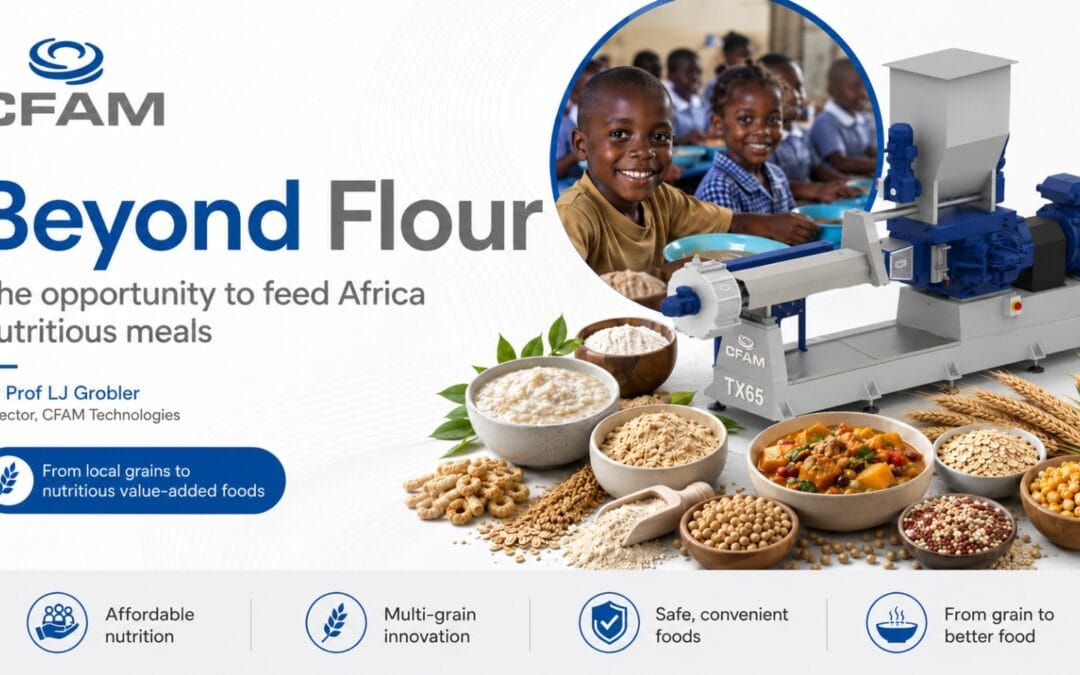
By Prof LJ Grobler, Director, CFAM Technologies
Africa stands at an important crossroads. The continent’s population continues to grow rapidly, urban lifestyles are changing, and consumers are demanding foods that are not only affordable, but also safe, nutritious and convenient. At the same time, rising food prices and increasing pressure on household budgets mean that millions of families struggle to access the quality nutrition they need every day. The challenge before us is therefore not simply producing more food. It is producing better food.
For decades, African millers have played a critical role in ensuring food security. They have built successful businesses by converting locally grown grains into staple products such as maize meal and wheat flour. These products remain essential to the diets of millions of people. However, the future of food manufacturing requires us to think differently. The question facing our industry today is whether we can use the crops we already produce to create foods that offer greater nutritional value, greater convenience and greater affordability. I believe we can, and that extrusion technology provides one of the most powerful tools to achieve this transformation.
Many people associate extrusion with breakfast cereals or snack foods. In reality, extrusion is one of the most versatile food processing technologies available. It allows us to transform grains and legumes into complete nutritional solutions designed to meet the needs of different consumers. Through extrusion, ordinary agricultural crops can be converted into instant porridges, nutritious multi-grain meals, complementary foods for infants, school feeding products and even stew-like formulations that provide a satisfying meal experience.
“Extrusion allows us to convert the grains that Africa already grows into safe, nutritious and affordable foods that can improve lives on a massive scale. It is technology with both commercial and social impact.”
– Prof LJ Grobler
One of Africa’s greatest strengths lies in the diversity of crops grown across the continent. Maize, sorghum, millet, rice, wheat and oats are widely cultivated, while legumes such as soybeans, cowpeas and Bambara groundnuts provide valuable sources of plant protein. Individually, these ingredients offer important nutritional benefits. Combined intelligently, they become even more powerful.
By blending grains and legumes, food manufacturers can develop multi-grain products with improved nutritional profiles. Protein quality can be enhanced through complementary amino acid patterns. Fibre levels can be increased. Minerals and naturally occurring vitamins can be improved. Flavour diversity can be expanded, while dependence on a single crop is reduced. Most importantly, these products can be manufactured using ingredients that are locally available and familiar to consumers.
This is particularly important when considering affordability. For many households, meat remains one of the most expensive components of the family food basket. While animal proteins provide excellent nutrition, they are often consumed less frequently because of their cost. Well-designed multi-grain formulations offer an opportunity to bridge this nutritional gap. They do not seek to replace meat entirely but rather provide affordable alternatives that deliver meaningful nutritional benefits to families who may not have regular access to expensive protein sources.
Extrusion makes this possible while also improving food safety. The combination of heat, pressure and mechanical energy used during the process reduces microbial contamination and produces shelf-stable products with excellent keeping qualities. The process also gelatinises starch and modifies protein structures, improving digestibility and making nutrients more accessible to the body. For consumers, this means products that are not only safer to consume, but also easier to prepare and digest.
Convenience has become one of the defining characteristics of modern food consumption. Working parents have less time available for meal preparation. School feeding programmes require products that can be prepared consistently and efficiently. Institutional kitchens demand reliability and simplicity. Extruded products address these needs by significantly reducing cooking times. Instant porridges can be prepared within minutes, while more substantial meal formulations require far less energy and labour than traditional alternatives. Reduced cooking requirements also mean lower fuel costs, an often overlooked but important advantage for low-income households.
One of the most remarkable aspects of extrusion is its flexibility. Products can be developed to suit almost any nutritional objective. Smooth instant porridges can be formulated for infants and young children. Thick, hearty meals can be designed for adults. Products with stew-like textures can provide consumers with familiar eating experiences while delivering enhanced nutritional benefits. Energy density, protein content, fibre levels and micronutrient profiles can all be adjusted to meet specific needs.
Whether the objective is a school feeding meal, a maternal nutrition product, an emergency relief ration, a complementary food for children or a specialised institutional formulation, extrusion provides the ability to meet precise nutritional specifications.
“Extrusion allows us to formulate foods to meet almost any nutritional specification while maintaining affordability and consumer acceptability. That combination is incredibly powerful.”
– Prof LJ Grobler
Another major advantage of extrusion lies in the opportunity for post-extrusion fortification. Many vitamins are sensitive to heat and may lose potency during conventional cooking processes. Nutrients such as Vitamin C, folic acid and several B vitamins can degrade when exposed to elevated temperatures, reducing their effectiveness.
By applying vitamins and minerals after the extrusion cooking process has been completed, manufacturers can significantly improve nutrient retention. Specialised coating systems allow micronutrients to be added accurately once the product has cooled. The benefits are substantial. Heat-sensitive vitamins are better protected, nutritional consistency improves, and consumers receive products that deliver the nutritional benefits intended by the manufacturer.
Simply put, the vitamins that go into the product are the vitamins that reach the consumer.
The implications extend far beyond technology. Governments seeking to strengthen school feeding programmes gain access to more effective nutritional solutions. Humanitarian organisations can provide shelf-stable products capable of delivering targeted nutrition to vulnerable populations. Food manufacturers can differentiate themselves by building brands associated with health, convenience and trust. Millers can move beyond commodities and create greater value from the grains they already process.
For consumers, the impact is even more profound. Families gain access to foods that are nutritious, affordable and practical. Children receive better nutrition during critical stages of development. Communities benefit from improved health outcomes. Better nutrition contributes to better educational performance, greater productivity and stronger societies.
“The future of food in Africa is not simply about producing more. It is about producing better. By combining local grains, nutritional science and extrusion technology, we can build businesses that are profitable while helping to create a healthier continent.”
– Prof LJ Grobler
Africa already possesses many of the ingredients required to achieve this vision. We grow the grains. We understand the nutritional challenges. We have entrepreneurs capable of innovation and businesses willing to invest in the future.
What is required now is the willingness to think beyond traditional boundaries.
The future of African food manufacturing lies beyond flour. It lies in transforming local agricultural resources into safe, affordable and nutritious meals that improve lives while creating sustainable business opportunities. Through extrusion technology, we could meet the nutritional needs of diverse populations, protect vulnerable nutrients through post-extrusion fortification, and develop products that compete successfully with more expensive food alternatives.
The opportunity before us is extraordinary.
The future is not simply about feeding more people.
It is about nourishing them better.
And through extrusion, that future is already within our reach.


